
Why should we teach our children and young people about enslavement and abolition?
‘Slavery involves human exploitation, indignity, suffering and
cruelty, and the transatlantic slave trade provides many of the
worst examples. However, its history also illustrates the power of
the human spirit to retain dignity, to resist injustice and regain the
right to liberty, irrespective of race or culture’
National Maritime Museum (United Kingdom)

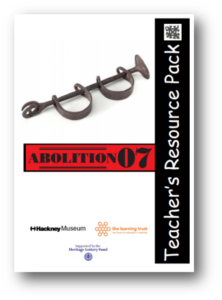
Before Teachers prepare to approach this important subject, it is really worth looking at the Teaching pack because it has some excellent advice for any educator. This resource pack accompanies the Abolition 07 exhibition at Hackney Museum. The exhibition explores the history of Britain’s involvement in the transatlantic slave trade and the legacy of slavery in 2007.
This pack explores the British involvement in the transatlantic slave trade and some of the forgotten heroes in history who helped to abolish it, both male and female, black and white. It provides access points into the study of the transatlantic slave trade. It will enable you and your students to explore this important but largely forgotten part of everyone’s past. The legacy of enslavement lingers today so the bicentenary should have a profound significance for people of the African Diasporas and others all over the world.

The Anti-Slavery Society Convention, 1840
by Benjamin Robert Haydon
oil on canvas, 1841
NPG 599
© National Portrait Gallery, London
Mary Prince
Mary Prince was born into enslavement on Bermuda around 1788, and sold away from her family at the age of ten. She was treated cruelly by a series of masters on several West Indian islands, enduring extreme hardship and sexual abuse. For years she was forced to work up to her waist all day in salt ponds, manufacturing salt. This work caused sun blisters on exposed parts of the body and painful boils and sores on the legs.
In 1828, she was brought from Antigua to England by her then owners, Mr and Mrs John Wood. Slavery was still legal in the West Indies, but no longer in Britain itself, so once in London, Prince left the Woods and went to the Anti-Slavery Society.
In 1829, she unsuccessfully petitioned parliament for her freedom, so she could return to her husband in Antigua without finding herself once again enslaved. She told her life story to abolitionist sympathisers, and it was published in 1831 as 'The History of Mary Prince' - attracting a large readership just as the anti-slavery movement was mounting a powerful and ultimately successful campaign for the emancipation of all Africans enslaved by the British.
Unfortunately, the remainder of Mary Prince's life is a mystery. It is unknown whether she died in Britain or was able to return, free, to Antigua.
(source BBC )
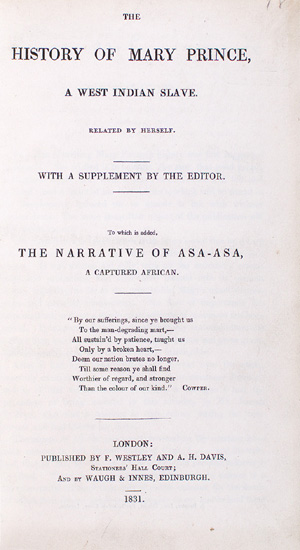 Press the book Cover to read the book.
The American academic Emily M.N Kugler has plotted the journey of Mary Price. Beginning in Bermuda, moving to the Turks and Caicos Island, back to Bermuda, then Antigua, and finally England, the text covers a wide swath of the Atlantic World. This a distance of approximately 11,035 kilometres (6,856.83 miles)
Further Reading
The Classic Slave Narratives, edited and with an Introduction by Henry Louis Gates, Jr., 1987, Penguin Books
Bermuda—Five Centuries by Rosemary Jones, 2004, Panatel VDS Ltd., Bermuda
The History of Mary Prince—A West Indian Slave, Related by Herself, edited with an introduction by Moira Ferguson, 1997, the University of Michigan Press
The History of Mary Prince—A West Indian Slave, edited with an introduction by Sara Salih, 2004, Penguin Books.
“Mary Prince—A Model of Courage and Independence” by Dr. Moira Ferguson, The Bermudian, May 1994.
“Slave story ‘exciting discovery’”—The Mid-Ocean News, January 8, 1988, pages 1,9.
“The Write Stuff” by Sandra Campbell, The Bermudian magazine, April 2000.
‘They bought me as a butcher would a calf or lamb’ by Sara Wajid, The Guardian, October 19, 2007